
Premium tiles are no longer simply a surface finish. Across hotel, commercial office, retail, and high-end residential developments, tiles have become a defining element of architectural language, shaping spatial experience, reinforcing brand identity, and directly influencing the quality of the user journey. What was once treated as a technical finishing material has evolved into architectural tile: a strategic specification that demands serious consideration of aesthetics, format, surface performance, and technical compliance.
1. Tiles Are No Longer a Secondary Material
In traditional design thinking, tiles were primarily specified for their functional properties, waterproofing, hygienic cleanability, and structural protection. In contemporary fit-out practice, however, tiles perform a far broader set of roles:
- They determine the overall visual impression of a space
- They create spatial continuity and establish scale
- They contribute to brand expression in retail and hospitality environments
- They allow premium aesthetics to be achieved at a controlled and predictable cost
Critically, in B2B specifications, premium tiles must deliver more than visual impact. They must satisfy long-term durability requirements, maintain color and dimensional stability, and support efficient building operations over the asset’s full lifecycle.
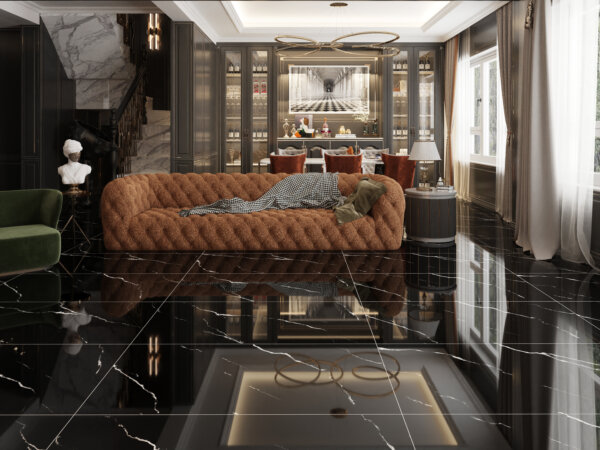
High-end tiles in interior design
2. Large-Format Tiles & Seamless Surfaces: Defining Trends for 2025-2026
2.1 Large-Format Tiles
The industry-standard formats that are driving premium interior specifications include:
- 600 x 1200mm
- 800 x 1600mm
- 1200 x 2400mm
- Oversized slabs for feature wall cladding and facade applications
The principal benefits of large-format tile specification are:
- A significant reduction in grout joint frequency, simplifying both aesthetics and maintenance
- An enhanced perception of spatial volume and openness
- The creation of a refined, continuous surface that reads as a single architectural plane
2.2 Seamless Surface Effects
- Photorealistic marble vein reproduction at scale
- Concrete, travertine, and metal surface effects
- A broad palette of surface finishes: matte, satin, and semi-polished
These advancements position architectural tile as a genuine alternative to natural stone, matching natural stone aesthetically, while offering superior consistency and significantly greater control across large-area installations.
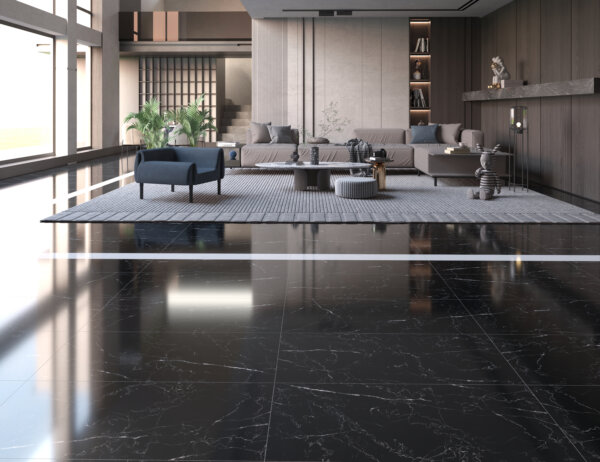
Large format tiles in architecture
3. Applications Across Commercial & Hospitality Environments
3.1 Hotel & Hospitality
- Main lobby and reception areas
- Guest corridor flooring and wall cladding
- Restaurant, lounge, and F&B zones
Specification requirements: slip resistance to appropriate R-rating, scratch and abrasion resistance, ease of maintenance under high-frequency operational conditions.
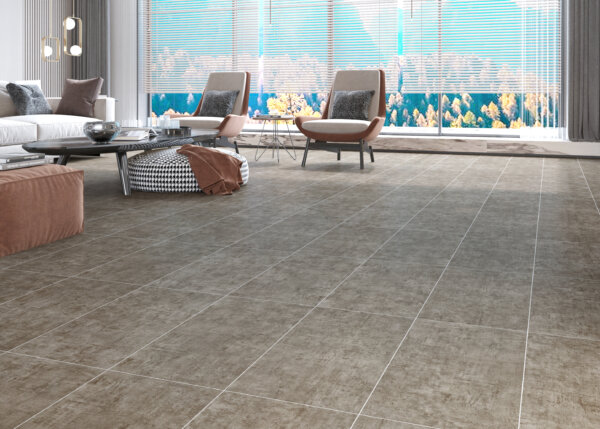
Architectural tiles in interiors
3.2 Office & Commercial
- Building lobby and entrance areas
- Client reception and meeting zones
- Pantry and amenity floor and wall surfaces
Specification requirements: high durability, low maintenance demand, consistency with the overall corporate design language.
3.3 Retail & Showroom
- Sales floor and product display areas
- Brand feature walls and backdrop surfaces
- Point-of-sale and checkout zones
Specification requirements: strong visual impact, structural load-bearing capacity, efficient installation turnaround to minimize retail downtime.
4. Technical Requirements for Large-Format Tile Installation
Large-format tiles deliver outstanding visual results, but impose significantly higher technical demands on the installation process:
4.1 Substrate Preparation
- Substrates must be flat to tight tolerances, deviation limits are markedly lower than for standard-format tile installations
- Moisture content must be verified and controlled prior to commencement of tiling works
4.2 Adhesive Systems & Support Structures
- Large-format specific adhesive mortars with extended open time and appropriate rheology
- Full back-buttering technique required, adhesive applied to both the substrate and tile back
- Mechanical support framing systems where large-format tiles are specified for vertical wall cladding applications
4.3 Joint & Movement Control
- Precise calculation and placement of movement joints to accommodate thermal expansion and substrate deflection
- Elimination of hollow voids beneath tiles, a critical failure mode in large-format installations
Large-format tile installation demands an experienced technical installation team and a rigorous, structured quality control process, particularly on B2B projects where multiple simultaneous work areas must maintain consistent standards.
5. Export & International Quality Standards
5.1 Mechanical Performance
- Low water absorption rate (classifying tiles as impervious or vitrified)
- High modulus of rupture and breaking strength
- Abrasion and wear resistance appropriate to the specified application class
5.2 Safety Standards
- Slip resistance classification (DIN 51130 R-rating or equivalent)
- Chemical resistance to cleaning agents and common substances
- Environmental safety, compliance with applicable emission standards
5.3 Production Quality Controls
- Batch-to-batch color and shade consistency verification
- Dimensional tolerance control within specification limits
- Correct calibration, grading, and packaging to international logistics standards
On large-scale fit-out projects, selecting a supplier with a stable, certified production operation and a proven quality management system is a critical risk mitigation strategy, protecting both the construction program and the design intent of the finished installation.
6. From Finish Material to Architectural Statement
Premium architectural tile has definitively outgrown the role of surface finish. Today, it functions as an integral component of the design strategy, shaping spatial character, elevating the user experience, and ensuring sustained operational performance across the full life of the building. When correctly specified and installed to the required standard, architectural tile can substitute for many natural materials while delivering measurable advantages in cost efficiency, dimensional consistency, durability, and long-term stability.
Related Posts
In an era defined by climate urgency, the concept of a ‘home’ or any high-quality interior environment can no longer be evaluated on comfort and aesthetics alone. A truly exceptional living or working space now demands environmental responsibility as a foundational design principle. Sustainable interior design, realized through the deliberate specification of green interior materials, […]
Earth tones and neutral color palettes have firmly established themselves as the defining aesthetic direction for luxury interior design in 2026. Widely adopted by leading architects and premium fit-out contractors alike, these grounded, nature-inspired schemes create interiors that are simultaneously refined, enduring, and highly versatile. From five-star hospitality to Grade-A commercial and high-end residential, neutral […]
Quartz stone has emerged as the material of choice across hotel, commercial office, and retail fit-out projects valued precisely for its ability to reconcile premium aesthetics with long-term operational performance. As an engineered stone manufactured under rigorous, controlled production processes, quartz delivers consistent durability, dimensional uniformity, and minimal maintenance requirements. These properties make it ideally […]
